
Table of Contents
SOC reports often come up during audits, vendor reviews, or compliance discussions, but their purpose isn’t always clear. Many businesses encounter SOC 1 for the first time when an auditor asks for it or when evaluating a third-party service that supports financial processes. Without context, it can be difficult to understand what SOC 1 actually measures and why it matters.
SOC 1 compliance focuses on controls that affect financial reporting accuracy, not general cybersecurity or privacy practices. In this guide, we will break down what SOC 1 compliance is, how it works, who it applies to, and the areas it does and does not cover, so businesses can better understand its role in audit readiness and third-party risk management.
What is SOC 1 compliance?
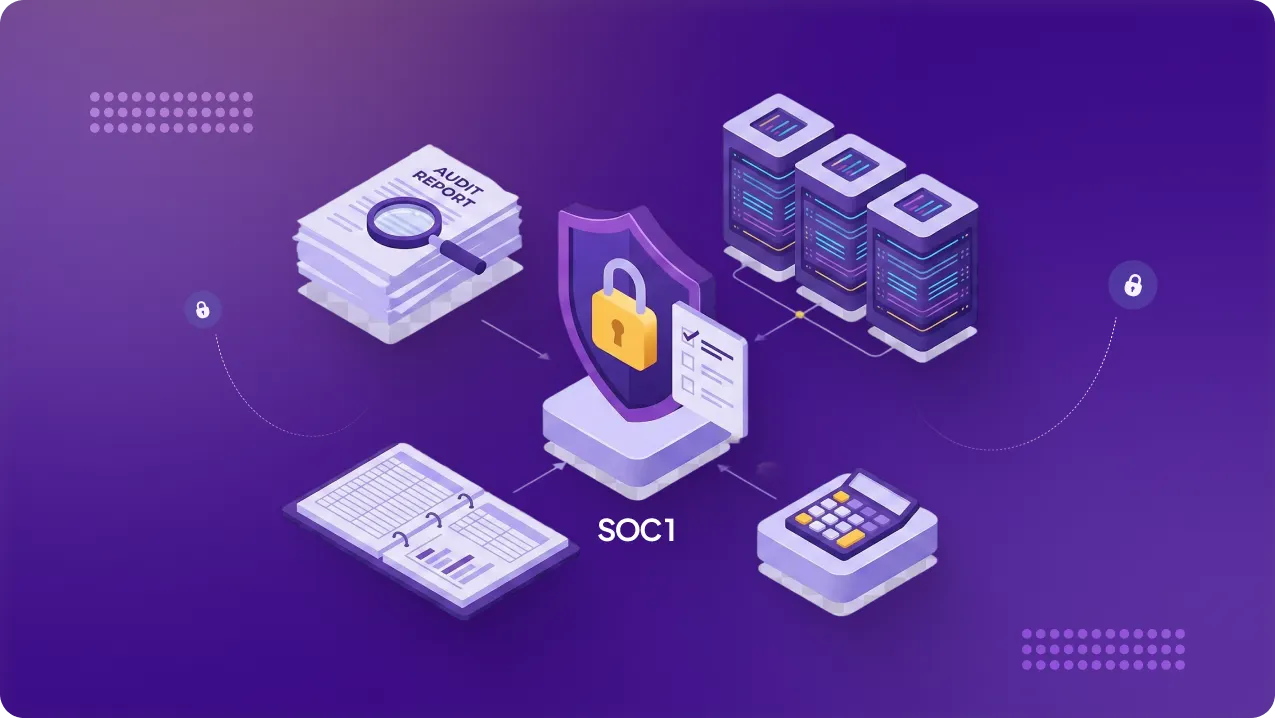
SOC 1 compliance refers to an independent examination of controls at a service organization that are relevant to financial reporting. It is designed to help businesses understand whether a third-party provider has controls in place that support the accuracy and reliability of their financial statements.
SOC 1 applies when a company’s systems, processes, or services can directly or indirectly impact a customer’s internal control over financial reporting (ICFR). It does not evaluate overall security or privacy practices, but focuses narrowly on financial reporting–related controls, such as how data is processed, reviewed, and managed within defined systems.
The outcome of a SOC 1 examination is a report prepared by an independent auditor. This report is commonly used by auditors, finance teams, and compliance stakeholders to assess third-party risk and support audit requirements without duplicating control testing.
How does SOC 1 compliance work?
SOC 1 compliance is evaluated through a structured examination process. Here’s an overview of how it works:
Framing and scope
SOC 1 examinations begin by defining which systems and processes are in scope for financial reporting. Only activities that could affect a customer’s financial statements are included. Organizations also determine whether the examination will result in a Type I report, which evaluates control design at a point in time, or a Type II report, which assesses how those controls operate over a defined period.
Risk and control design
Once scope is defined, organizations identify risks that could impact financial reporting accuracy. Controls are then designed to address those risks, such as approval processes, access limitations, or review procedures. The focus remains on relevance to financial reporting rather than broad operational or security practices.
Documentation and evidence
SOC 1 requires clear documentation of how controls are designed and performed, including written policies, process descriptions, and records showing controls were executed as intended. Consistent documentation helps auditors understand how controls support financial reporting objectives.
Testing and examination
An independent auditor evaluates whether controls are suitably designed and, in a Type II examination, whether they operate effectively over time. This review is based on evidence, walkthroughs, and sample testing rather than assumptions or representations alone.
Reporting and use
At the end of the examination, the auditor issues a SOC 1 report summarizing the scope, controls reviewed, and test results. Businesses and their auditors use this report to assess third-party risk and support financial audits without duplicating control testing.
Requirements for SOC 1 compliance
SOC 1 compliance focuses on several defined control areas:
Control environment
The control environment sets the foundation for how controls are designed and enforced across the organization. SOC 1 examinations look at governance structures, management oversight, role definitions, and segregation of duties to determine whether responsibility and accountability for financial reporting controls are clearly established.
Risk assessment
Risk assessment focuses on how an organization identifies and evaluates risks that could affect financial reporting accuracy. SOC 1 considers whether risks are assessed in a structured way and whether changes to systems, processes, or operations are evaluated for their potential impact on financial controls.
Control activities
Control activities are the specific actions and procedures used to address identified risks. These may include approval processes, review mechanisms, reconciliations, or access-related controls that help prevent or detect errors in financial data. SOC 1 evaluates whether these controls are appropriately designed and consistently applied.
Information and communication
This area examines how financial information is captured, processed, and communicated within the organization. SOC 1 considers whether relevant information flows to the right individuals in a timely manner and whether communication supports the effective operation of financial reporting controls.
Monitoring activities
Monitoring activities assess how controls are reviewed over time. SOC 1 looks at whether organizations perform ongoing or periodic evaluations of control effectiveness and whether identified issues are addressed through documented remediation and follow-up processes.
User entity controls
SOC 1 reports may identify user entity controls, which are controls that customers are expected to operate as part of the overall control environment. These controls acknowledge shared responsibility and help clarify how service organizations and their customers collectively support accurate financial reporting.
Documentation requirements
Documentation is a core requirement across all SOC 1 control areas. Organizations are expected to maintain clear records of control design, execution, and oversight, including policies, procedures, and supporting evidence. This allows auditors to understand how controls operate and how they support financial reporting objectives.
Benefits of SOC 1 compliance
SOC 1 compliance provides several practical benefits for businesses:
- Supports audit readiness: SOC 1 reports provide auditors with independent assurance over controls relevant to financial reporting. As a result, the need for duplicative testing during audits may be reduced, helping streamline audit timelines for both service organizations and their customers.
- Improves third-party risk visibility: For businesses relying on external service providers, SOC 1 reports offer insight into how those providers manage controls tied to financial processes. Increased visibility helps organizations better understand and manage third-party risk related to financial reporting.
- Clarifies control responsibilities: SOC 1 reports clearly distinguish between controls operated by the service organization and user entity controls that customers are responsible for. Clear role definition helps reduce confusion around shared responsibilities and supports more effective control alignment.
- Enhances trust with stakeholders: SOC 1 compliance signals that an organization has undergone independent review of its financial reporting controls. Independent validation can support trust with customers, auditors, and other stakeholders who rely on the accuracy of financial information.
- Encourages control consistency: Preparing for and maintaining SOC 1 compliance often leads organizations to formalize control documentation and monitoring practices. Over time, this structure can help promote consistency in how financial reporting controls are applied and reviewed.
Who needs SOC 1 compliance?
SOC 1 compliance is relevant for organizations whose services can affect a customer’s financial reporting:
Service organizations
Service organizations are often the ones that pursue SOC 1 compliance when their services can influence a customer’s financial reporting. This commonly includes providers supporting payroll, billing, transaction processing, or financial data handling.
Businesses subject to financial audits
Businesses undergoing financial statement audits may need SOC 1 reports from third-party providers. Auditors use these reports to understand how external services affect internal control over financial reporting and what extra work may be required.
Companies relying on third-party financial processes
Organizations that outsource financial processes or rely on external platforms for financially relevant workflows often look for SOC 1 reports from those providers. These reports help clarify whether controls supporting financial reporting are in place and operating as described.
Organizations evaluating vendor risk
SOC 1 compliance is also relevant during vendor reviews when a provider’s services could affect financial reporting outcomes. It can support procurement, finance, and compliance stakeholders by providing structured information about controls tied to financial reporting.
Common SOC 1 compliance challenges
Organizations can encounter practical challenges when preparing for or maintaining SOC 1 compliance:
Defining the appropriate scope
One common challenge is determining which systems and processes should be included in the SOC 1 examination. Including too much can dilute focus, while excluding relevant activities can create gaps that auditors flag during reviews.
Aligning controls with financial reporting impact
Organizations may struggle to clearly link controls to financial reporting outcomes. SOC 1 requires controls to be relevant to internal control over financial reporting, which can be difficult when processes support both financial and non-financial functions.
Maintaining consistent documentation
SOC 1 examinations rely heavily on documentation to demonstrate how controls are designed and performed. Keeping documentation current and consistent across teams and reporting periods can be challenging, especially as systems or processes change.
Coordinating across teams and stakeholders
SOC 1 compliance often involves multiple teams, including finance, operations, IT, and compliance. Coordinating responsibilities, timelines, and evidence collection across these groups can require ongoing alignment and communication.
Managing user entity control dependencies
When SOC 1 reports include user entity controls, organizations must clearly define which controls customers are responsible for. Misalignment or misunderstanding around these shared responsibilities can lead to confusion during audits or vendor reviews.
What SOC 1 compliance does not cover?
Since SOC 1 focuses on financial reporting controls, there are several areas it does not address:
- General cybersecurity practices: SOC 1 does not assess an organization’s overall cybersecurity posture. Controls related to network security, threat detection, or incident response are only considered if they directly affect financial reporting.
- Data privacy and regulatory compliance: SOC 1 does not evaluate compliance with data protection or privacy regulations. Requirements related to personal data handling, consent, or privacy governance fall outside its scope unless they impact financial reporting controls.
- Operational or business performance: SOC 1 does not measure operational efficiency, service quality, or business outcomes. Its focus remains on control design and operation rather than how well a service performs in practice.
- Controls unrelated to financial reporting: SOC 1 only evaluates controls that affect internal control over financial reporting. Controls, systems, or processes that do not influence financial reporting are out of scope, even if they relate to areas such as security, availability, or privacy.
SOC 1 vs. SOC 2 compliance
| Aspect | SOC 1 | SOC 2 |
| Primary focus | Controls relevant to financial reporting (ICFR) | Controls related to the Trust Services Criteria |
| Purpose | Supports financial statement audits and ICFR reliance | Provides assurance over system security and operational controls |
| Typical audience | Auditors, finance teams, compliance stakeholders | Customers, partners, security and risk teams |
| Scope of controls | Financial systems and processes that impact reporting | Systems handling data and service delivery |
| Common use cases | Financial audits and vendor assurance | Vendor security reviews and trust assessments |
| Evaluation basis | SSAE 18 (SOC 1 reporting) | Trust Services Criteria (AICPA) |
Frequently asked questions
SOC 1 compliance means that a service organization has undergone an independent examination of controls relevant to financial reporting. The resulting report helps auditors and businesses understand how those controls are designed and, in some cases, how they operate over time.
No, SOC 1 is not a certification. It is an independent examination that describes and evaluates controls related to financial reporting.
A SOC 1 report is prepared by an independent certified public accountant. The CPA evaluates the service organization’s controls in accordance with professional attestation standards.
SOC 1 focuses on controls relevant to financial reporting, while SOC 2 focuses on controls related to system security and operational trust based on the Trust Services Criteria. They serve different purposes and are used in different assurance contexts.
SOC 1 is not legally mandatory. However, it is often required by customers, auditors, or contractual obligations when a service organization’s controls affect financial reporting.
A SOC 1 Type I engagement is often completed within a few weeks to a couple of months, since it evaluates control design at a single point in time. A SOC 1 Type II engagement typically takes several months, as it includes an observation period followed by testing and reporting.
Costs depend on factors such as system complexity, scope, and report type. SOC 1 Type I reports generally cost several thousand dollars, while SOC 1 Type II reports are higher, reflecting the extended testing period and additional audit effort required.
A SOC 1 Type I report evaluates whether controls relevant to financial reporting are appropriately designed at a specific point in time. A SOC 1 Type II report goes further by evaluating both the design of those controls and how effectively they operate over a defined period, typically several months.