
Table of Contents
Fintech companies often rely on third parties for payments, identity verification, fraud detection, cloud infrastructure, development, and compliance. Some of those providers need access to internal systems, applications, APIs, infrastructure, or customer data so they can perform their responsibilities.
Third-party integration security becomes harder when that access comes through different paths. Vendor employees may sign in directly, while integrations may rely on service accounts, API keys, tokens, or other credentials. Each access path needs to stay limited to what the vendor actually requires and remain easy to review or remove.
Operational risk matters as well. If a critical provider becomes unavailable or has to be disconnected during an incident, the impact can reach the business processes that depend on it. In this blog, we will look at where vendor access creates risk and what fintech teams can do to control it.
Why Vendor Access Creates Security Risk in Fintech
Vendor access can reach sensitive parts of a fintech environment. The difficulty is that fintech teams do not have the same direct control over a vendor’s employees, devices, networks, or internal security practices as they do over their own workforce. A compromised third-party account or integration credential can create another route into systems the business relies on.
The level of risk also depends on how much access the vendor has. A provider that only needs access to one application presents a different exposure from one that can reach production systems or multiple internal environments. The same applies to integrations. An API credential with broad permissions can expose more systems or data if that credential is compromised.
None of this means the vendor has to be malicious. Legitimate third-party access can still become a security problem when permissions are broader than necessary or access remains in place after the original need has changed.
Where Vendor Access Commonly Goes Wrong
Vendor access becomes riskier when permissions or access duration are not kept under control. Common weak points include:
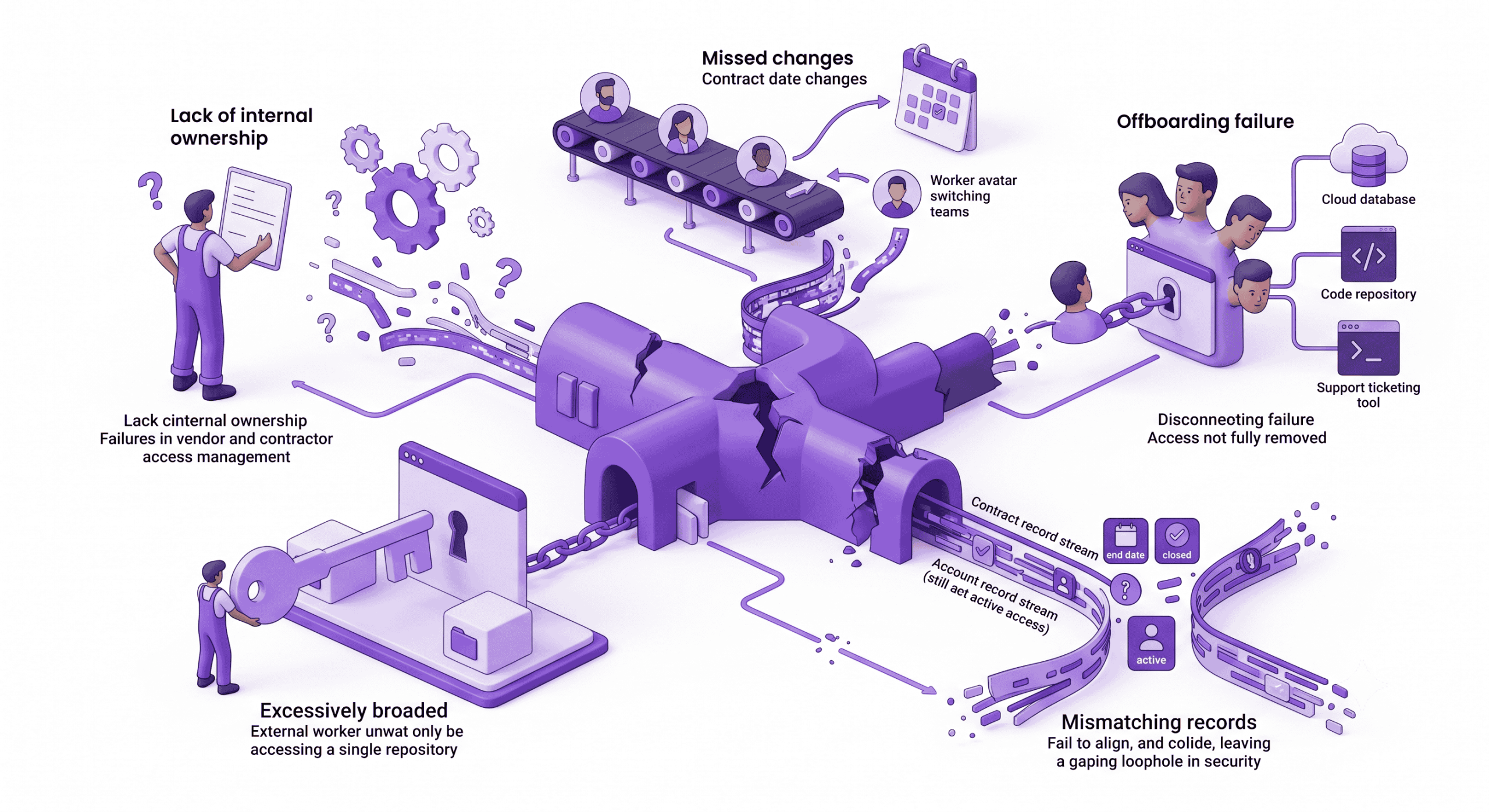
- Access is broader than the work requires: A vendor may be able to reach systems, data, or environments that are not necessary for its role. Integration credentials can create the same issue when they carry permissions beyond their intended function.
- Accounts are shared or authentication is weaker: When several vendor employees use the same account, it becomes harder to tie activity back to an individual. Risk also increases when third-party users are subject to weaker authentication requirements than internal users.
- Permissions remain active after the need changes: Vendor accounts can remain in place after a project ends, responsibilities shift, or personnel change. API keys, tokens, and service accounts can also remain valid after an integration is changed or retired.
- Connections come from unmanaged devices or networks: External users may connect from environments that sit outside the fintech company’s own device and network controls, reducing how much control the internal team has over the connection point.
- Vendor activity is difficult to distinguish or investigate: Limited visibility can make it harder to establish which third party connected, when the connection occurred, or which systems were involved.
What Fintech Teams Can Do to Control Third-Party Access
Vendor access should stay limited to what the work requires and be easy to change or remove when that work changes. The following controls help keep it that way:
Limit Access to What Is Actually Required
Vendor permissions should match the work being performed. A provider that only needs one application should not automatically receive access to other systems or environments. The same applies to integration credentials, which should only carry the permissions their function requires. Production, development, testing, and administrative access can also be separated where needed.
Related Read: Implementing the Principle of Least Privilege
Use Individual Accounts and Strong Authentication
Vendor personnel should use their own accounts rather than shared credentials. Individual accounts make it easier to apply authentication requirements and tie activity back to a specific user. MFA and existing identity controls can also be applied where supported. If one vendor employee leaves or is replaced, their credentials should not simply pass to someone else.
Treat Integration Credentials as Access Credentials
API keys, tokens, and service accounts can provide access without a person signing in, so they need the same level of attention as user accounts. Their permissions should remain narrowly scoped, and credentials that are no longer required should be revoked. Rotation should follow the organization’s credential-management requirements.
Restrict How Vendors Reach the Environment
Identity controls determine who or what is connecting, while network controls can limit how that connection reaches the environment. That can include IP allowlisting, network segmentation, approved access paths, static IPs, or managed VPN access. A business VPN can be useful when vendor users need traffic routed through an encrypted VPN connection or a consistent IP address for allowlisting.
Assign Ownership and Set Review Points
Third-party access should have a clear internal owner. Someone needs to know who approved it, what it is for, and when it should be reviewed. Access can also be tied to a defined expiry date or review point where appropriate, which makes it less likely to remain in place simply because no one has revisited the original request.
Review Access When the Relationship Changes
Vendor access should change when the work changes. A new project, different responsibilities, a personnel change, or the end of an integration can all affect what access is still needed. Reviews should cover both user accounts and machine credentials so that old permissions, tokens, or service accounts do not remain active after their purpose has changed.
Keep Enough Visibility to Investigate Activity
Security teams should be able to distinguish third-party activity from ordinary internal access. Useful connection records should make it possible to establish who or what connected, when the connection occurred, which access path was used, and which systems were involved. That information can help teams investigate vendor activity and remove access quickly if needed.
Planning for Vendor Disruption
Access controls are only part of the problem. Fintech teams also need to know what happens if a vendor or integration becomes unavailable or has to be disconnected. A few questions are worth answering before that happens:
| Question | What to Look At |
| What depends on the vendor? | Identify the systems or processes that would be affected if the vendor or integration stopped working |
| What happens if access is suspended? | Removing access during an incident may also interrupt the service the vendor supports |
| How quickly can the vendor be disconnected? | Teams should know what can be shut off immediately and what could cause wider disruption |
| Is there a fallback? | Check what happens if the service or integration becomes unavailable |
| Who can make the call? | Responsibility for suspending or restoring access should already be clear |
A vendor may need to be cut off quickly during an incident, but doing so can affect the systems or processes that rely on it. Knowing those dependencies in advance helps teams make that call with fewer surprises.
Frequently Asked Questions
Vendor access usually refers to people from an external company signing in to systems or applications. Third-party integration access is often machine-to-machine, using API keys, tokens, service accounts, or similar credentials. Both need clear limits, but the way they are authenticated and reviewed can differ.
Some vendor relationships may require ongoing access, but that does not mean the access should go unchecked. Permissions should still match the work being done, have a clear owner, and be reviewed when roles, systems, or requirements change.
Teams should first determine which accounts, credentials, systems, or integrations may be affected. Access can then be restricted or removed where needed, and exposed credentials may need to be revoked or rotated based on the situation and the organisation’s incident response process.
A business VPN can help by routing vendor traffic through an encrypted VPN connection and providing a consistent IP address for allowlisting. However, it does not replace identity controls, MFA, application permissions, segmentation, or other access controls.